

 VN
 한국어


LS Law Firm always works as a team
Each case at LS Law Firm is handled by a team of 2–3 members, including lawyers and legal assistants, ensuring efficiency and quality. For complex or urgent matters, we increase the number of team members to deliver the best outcome.


Ho Chi Minh City proposes 127 land lots for the pilot implementation of commercial housing projects under Resolution 171 – A significant opening step for the 2025 real estate market
Implementing Resolution No. 171/2024/QH15 of the National Assembly and Decree No. 75/2025/ND-CP of the Government on the pilot implementation of commercial housing projects through agreements to acquire land use rights, the Ho Chi Minh City People's Committee has submitted to the City People's Council a list of 127 land lots eligible for pilot implementation in 2025 (Phase 3). This is considered a step of particularly important significance in the process of removing legal bottlenecks for the current real estate market.
Review of Over 500 Applications, Strict Screening Based on Six Legal Criteria
According to the consolidated report of the Department of Agriculture and Environment, by the end of April 2025, a total of 546 applications had been submitted for the pilot project, including:
-
Ho Chi Minh City (former): 438 applications;
-
Ba Ria – Vung Tau (former): 108 applications.
After three rounds of screening, the City People’s Council approved:
-
Phase 1: 54 land plots;
-
Phase 2: 42 land plots;
-
Phase 3: an additional 127 land plots meeting all conditions.
The evaluation of these land plots was conducted strictly in accordance with six mandatory criteria: compliance with land-use planning, housing development programs, urban development zones, not exceeding 30% of the additional residential land quota, not subject to compulsory land recovery, and not belonging to projects requiring investor selection through bidding. The 127 plots in Phase 3 cover a total area of approximately 7,904,000 m².
According to the submission, the 127 qualified plots in Phase 3 include:
-
Total area: approximately 903,008 m²;
-
Residential land: approximately 198,595 m²;
-
Converted rice land: over 1.24 million m²;
-
Converted forest land: over 000 m².
Specifically:
-
Ho Chi Minh City: 113 plots with a total area of nearly 4.45 million m²;
-
Ba Ria – Vung Tau: 14 plots with a total area of more than 3.45 million m², concentrated in the Long Son – Go Gang area.
Meanwhile, 246 plots deemed ineligible were excluded from the list due to planning violations, excessive residential land ratios, or other legal constraints.
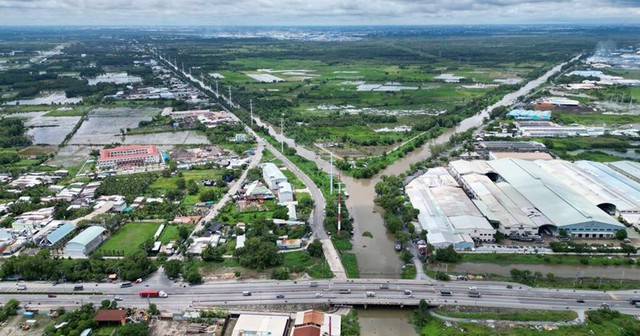
(Illustrative image)
Strict Control of the 30% Ceiling for Additional Residential Land
One of the key provisions of Resolution 171 is the limitation of the additional residential land area to a maximum of 30% during the 2021–2030 planning period.
-
In Ho Chi Minh City, after two rounds, over 248 hectares of residential land have been used, leaving a valid balance of about 38 hectares.
-
In Ba Ria – Vung Tau, after two rounds, 426.7 hectares were used, leaving a balance of approximately 181.7 hectares.
The review confirms that all 127 plots in Phase 3 fall within the 30% threshold, ensuring strict compliance with urban planning and sustainable development balance.
Unlocking Legal Bottlenecks for Equitized Land
The report also clarifies a legal issue of particular interest to enterprises: land originating from state-owned enterprises after equitization.
Under current regulations, the law does not prohibit changing the land-use purpose for pilot project implementation if:
-
The enterprise no longer holds state capital;
-
The project fully complies with the conditions under Resolution 171;
-
Land price determination during conversion must follow market-based mechanisms to prevent budget losses.
This serves as an important legal foundation to unlock long-stalled projects that have been on hold for many years.
12 Plots in Long Son – Go Gang: Forest Land or Residential Land?
The group of 12 land plots in Long Son Commune (Ba Ria – Vung Tau) received the most in-depth legal analysis in the report due to their connection with protective forest land.
Verification results indicate that:
-
Residents have used the land stably since before 1985, with continuous cadastral records over multiple periods;
-
The 2024 land inventory recorded a reduction of over 771 hectares in Long Son’s protective forest area, adjusted to reflect actual land use;
-
The National Forestry Plan to 2030 confirms that these plots are outside designated forest planning zones.
Notably, a final administrative judgment by the High People’s Court in Ho Chi Minh City affirmed that: individuals who have used land stably and are registered in the cadastral system remain eligible for compensation in case of state expropriation, even if their plots appear within old forest boundary records.
On this basis, 14 plots in the area have been determined as legally qualified for pilot implementation.
No Bidding, No Expropriation – Implemented Under a Negotiation Mechanism
A key feature of the 127 Phase-3 plots is that they are not subject to land recovery and not included in the list requiring investor selection through bidding.
These projects will be implemented under the following mechanism:
-
Funded by non-state capital;
-
Investors negotiate directly to acquire land-use rights;
-
Fully compliant with principles under the Land Law 2024 and Resolution 171.
This approach significantly shortens investment procedures and reduces potential administrative disputes related to land recovery.
Practical Impact on the Real Estate Market
Ho Chi Minh City’s continued proposal of 127 pilot land plots in Phase 3 carries significant implications:
-
Supplements the legal land supply for commercial housing projects;
-
Resolves multiple long-standing “legal bottlenecks” involving forest land, rice land, equitized land, and overlapping planning;
-
Establishes a transparent and safer legal framework for investors;
-
While still ensuring strict compliance with planning indicators and sustainable land-use protection.
From a legal perspective, Resolution 171/2024/QH15 is not merely a pilot mechanism—it represents a gradual transformation in legal mindset and land governance approach for commercial housing development. The mechanism of “negotiation – transparency – market orientation” replaces traditional administrative procedures. The third pilot phase in 2025 in Ho Chi Minh City vividly demonstrates efforts to translate legal reforms into practical action, paving a new path for land resource management and utilization.
In summary, Ho Chi Minh City’s bold proposal to include 127 additional pilot plots not only expands the scope for commercial housing development but also reflects the government’s determination to actualize new land mechanisms. This marks an important step forward for 2025, contributing to the stabilization of the real estate market and reinforcing confidence among enterprises and investors entering a new phase of growth.
Lawyer Ho Vuong Quoc Su
Managing Partner – LS Law Firm
Website: lslawfirm.com.vn
Email: su.ho@lslawfirm.com.vn


