

 VN
 한국어


LS Law Firm always works as a team
Each case at LS Law Firm is handled by a team of 2–3 members, including lawyers and legal assistants, ensuring efficiency and quality. For complex or urgent matters, we increase the number of team members to deliver the best outcome.


HCMC proposals 127 land area to implement commercial housing projects in accordance with resolution 171 – an important step for the real estate market in 2025
Reviewed more than 500 profiles, strictly screened according to 6 legal criteria According to the General Report of the Department of Agriculture and Environment, by the end of April 2025, the total number of applications for pilot project implementation was 546, of which: Ho Chi Minh City (old): 438 records; Ba Ria – Vung Tau [...]
Reviewed more than 500 profiles, strictly screened according to 6 legal criteria
According to the General Report of the Department of Agriculture and Environment, by the end of April 2025, the total number of applications for pilot project implementation was 546, of which:
- Ho Chi Minh City (old): 438 records;
- Ba Ria – Vung Tau (old): 108 records.
After three rounds of screening, the City People’s Council approved:
- Phase 1: 54 plots of land;
- Phase 2: 42 plots of land;
- Phase 3: continue to propose 127 land plotseligible
The evaluation of land plots is strictly carried out according to 6 mandatory criteria, including: compliance with land use planning, housing development program, urban development area, not exceeding 30% of additional residential land fund, not subject to compulsory land acquisition, not in the list of projects requiring bidding to select investors. 127 land plots in the third phase have a total area of nearly 7,904,000 m².
According to the report, 127 eligible land plots in the third phase include:
- Total area: approximately 7,903,008 m²;
- Residential land area: approximately 4,198,595 m²;
- Rice land converted for other purposes: more than 24 million m²;
- Forest land converted to other purposes: more than 41,000 m².
In there:
- Ho Chi Minh City: 113 land plots, total area of nearly 45 million m²;
- Ba Ria – Vung Tau: 14 land plots, total area of more than 45 million m², concentrated in Long Son – Go Gang area.
At the same time, 246 ineligible land plots were removed from the List due to planning violations, exceeding residential land quotas or being entangled in other legal conditions.
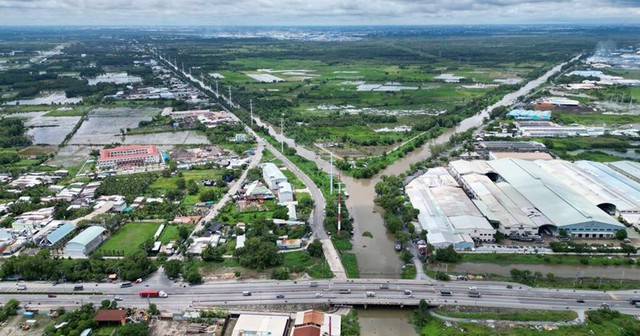
Illustration photo
Strict control of the ceiling of 30% of additional residential land fund
One of the key points of Resolution 171 is to control the maximum 30% increase in residential land area in the 2021-2030 planning period.
- In Ho Chi Minh City, after 2 phases, more than 248 hectares of residential land have been used, the remaining valid fund is about 3,038 hectares.
- In Ba Ria – Vung Tau , after 2 phases of using 7 hectares, the remaining fund is about 181.7 hectares.
The review results confirmed that all 127 land plots in the third phase are within the 30% allowable limit, ensuring strict compliance with planning and balanced sustainable urban development.
Opening the legal “bottleneck” for land originating from equitization
The report also clarifies a legal issue of particular concern to businesses: land originating from equitized state-owned enterprises.
According to current regulations, the law does not prohibit changing land use purposes to implement pilot projects, if:
- Enterprises no longer have state capital;
- Fully meet the conditions of Resolution 171;
- Determining land prices when changing purposes must follow market mechanisms to avoid budget losses.
This is considered an important legal basis for many projects that have been “suspended” for many years to be revived.
12 Long Son – Go Gang land plots: forest land or people’s land?
The group of 12 land plots in Long Son commune (Ba Ria – Vung Tau) is the most thoroughly analyzed content in the Report because it is related to protective forest land.
Verification results show:
- People have used it stably since before 1985, declared in land records over many periods.
- The 2024 land inventory recorded a decrease of more than 771 hectares of protective forest land in Long Son, due to adjustments according to actual usage status.
- The national forestry plan to 2030 identifies these lands as outside the forest planning.
In particular, an effective administrative judgment of the High People’s Court in Ho Chi Minh City also affirmed: in cases where people use land stably and have land registration, they are still eligible for compensation when the State reclaims it, even if it is within the forest land boundary according to old records.
On that basis, 14 land plots in this area were determined to have sufficient legal conditions to carry out the pilot.
No bidding, no recall – done by agreement
A very notable point is that the 127 land lots in the third phase are not on the land acquisition list and are not subject to bidding to select investors.
Projects are implemented according to the following mechanism:
- Non-budgetary investment capital;
- Investors agree to accept the transfer of land use rights;
- In accordance with the principles of the Land Law 2024 and Resolution 171.
This helps to significantly shorten investment procedures and limit the occurrence of administrative complaints regarding land recovery.
Practical impact on real estate market
The fact that Ho Chi Minh City continues to propose 127 pilot land plots in the third phase has many meanings:
- Contribute to supplementing legal land fund for commercial housing;
- Removing many remaining “legal bottlenecks” related to: forest land; rice land; equitized land; overlapping planning.
- Create a more transparent and safer legal corridor for investors;
- At the same time, strictly control planning indicators and protect land resources.
From a legal perspective, it can be affirmed that Resolution No. 171/2024/QH15 is not merely a pilot mechanism, but is gradually reshaping the mindset and approach to land access in the development of commercial housing. The principle of “agreement – transparency – market orientation” has been placed at the forefront, replacing the traditional administrative approach. The third pilot phase in 2025 in Ho Chi Minh City stands as a vivid testament to the city’s efforts to translate legal mechanisms into practical action, paving a new path for land resource governance and utilization.
In summary, Ho Chi Minh City’s bold proposal to add 127 pilot land plots not only expands the scope for commercial housing development but also demonstrates the government’s determination to realize new land-related mechanisms. This is an important step towards 2025, contributing to the stability of the real estate market and building confidence for businesses and investors in the new development phase.
Attorney Ho Vuong Quoc Su
Executive Attorney – LS LAW FIRM


